
Water Heater Maintenance in Salt Lake City, UT
Our maintenance visit is a condition report on the tank, not a checklist read aloud: flush, anode, relief valve, expansion, flue and temperature, with the findings you can act on.
Most water heaters are replaced for a reason that maintenance would have caught a year earlier: a spent anode, a relief valve that stopped sealing, or a layer of sediment that baked onto the tank bottom. In a heating-dominant climate with 5,154 heating degree days a year (NOAA), the burner runs long and the tank works for its living.
Why Choose Us for Water Heater Maintenance in Salt Lake City
The anode is the point of the visit
A flush removes sediment, but the anode is what keeps the steel from rusting through. We pull and inspect the rod, measure what is left and tell you whether the tank still has protection. Most maintenance visits that skip this step are cosmetic.
The flush is done with the tank understood
Draining a tank is easy; knowing whether the drain valve will reopen, whether the sediment has hardened, and whether the tank is safe to disturb is the part that matters. On older tanks we check the valve and the relief train before we start.
Gas safety is checked, not assumed
On a gas tank we look at the flue, the draft hood and the combustion air, because an appliance that vents into a shared chimney in a 1963 house can spill rather than draft. At 4,579 feet the margin for a starved burner is thinner than at sea level.
Findings come with a repair-or-replace line
A maintenance visit should end with a clear statement: what is healthy, what needs a part, and whether the tank is worth another year. If the anode is gone and the tank is past ten years, we say so instead of selling a flush.
WHY ACT NOW
Why Water Heater Maintenance Can't Wait in Salt Lake City
Maintenance is a seasonal argument here. The January normal low is 24.2 degrees Fahrenheit and the airport averages 51.9 inches of snow a season (NOAA 1991-2020 normals), which means the tank carries its heaviest load exactly when the house can least afford a failure. A tank serviced in early autumn goes into that stretch with a tested relief valve and a flue that has been looked at.
The cost of waiting is cumulative rather than dramatic. Sediment insulates the burner from the water, so the tank fires longer for the same hot water and the steel runs hotter. A relief valve that weeps quietly corrodes its own seat and the discharge line. An anode that is used up lets corrosion move into the tank wall, where nothing can be done about it. None of those announce themselves until the tank leaks.
There is also a decision value in the visit. Knowing the anode condition and the sediment level turns a future emergency into a planned replacement, and a planned replacement is the one where the closet gets measured and the venting gets designed.
Book it before the first hard freeze rather than after. A tank that is already rumbling in September has a season of long burner runs ahead of it, and the visit is cheapest while nothing is broken.
THE SIX CHECKS
Proof: What Water Heater Maintenance Actually Checks
A maintenance visit is only worth the time if it changes what you know about the tank. These six checks are the ones that produce a decision: keep it, repair it, or plan a replacement. Each is a physical inspection with a finding attached, not a box ticked on a form. The order matters as well, because the flush comes after the tank has been assessed and the anode comes before the flush on a tank that may be at the end of its life. On a gas tank the safety checks come first, because a flue problem is not something to discover on the way out. Everything below is done with the tank isolated and the water cooled, and everything found is written down so the next visit has a baseline to compare against.
Annual Flush and Sediment Removal
Water carries dissolved minerals, and in a storage tank those minerals settle out as sediment on the bottom, directly above the burner. The layer insulates the water from the flame, so recovery slows, the tank runs longer and the steel runs hotter than it was designed to. The popping and rumbling homeowners describe is steam forming under that crust. A flush drains the tank and pulls the loose sediment out through the drain valve. It does not remove scale that has baked on for years, and it will not rescue a tank whose bottom is already corroding. Flushing is preventive work on a healthy tank, and a diagnostic finding on a tired one. How often it pays depends on how much sediment the water carries and how hard the burner has to work to heat through it.
Anode Rod Inspection and Replacement
The anode is a sacrificial metal rod that corrodes so the steel tank does not, and it is the single best indicator of how much life a tank has left. We isolate the tank, depressurise it, remove the rod and measure what remains. A rod with two-thirds of its material left is doing its job. A rod that is down to the core wire has stopped protecting anything, and corrosion is now working on the tank wall. Replacing a partially spent rod extends tank life; replacing one on a tank that already shows rust in the hot-water line does not undo the damage. The finding, not the replacement, is the value of the check, and it is the first item we record on every maintenance visit.
T&P Relief Valve Testing and Replacement
The temperature-and-pressure relief valve is the tank's last safety device. It should open if temperature or pressure exceeds its rating, and it should reseat cleanly afterwards. We lift the lever with the tank at temperature, watch it discharge and confirm it closes. A valve that weeps after testing, is corroded, or has been capped or plugged is replaced, because a capped relief valve turns a pressure problem into a tank failure. The discharge pipe is checked at the same time: it must run to a safe point and must not be reduced or threaded at the end. Testing a valve that has not moved in a decade sometimes reveals that it will not reseat, which is why the test is done with a replacement on the truck.
Combustion, Draft and Flue Inspection
On a gas tank, the flue is as important as the burner. We check the draft hood for spillage, look for corrosion or debris in the flue, confirm the rise and the clearances, and check that the room has combustion air. At 4,579 feet (USGS) the air is thinner, so a burner starved of air by a solid closet door or a dryer venting into the same space can produce more carbon monoxide for the same flame. A shared masonry chimney in a pre-1970 house is the case that most often needs attention, especially where a high-efficiency furnace was added later and left the water heater alone on an oversized flue. Where spillage is found, the flue is the repair, not the tank.
Temperature Settings and Scald Control
Tank temperature is a balance between storage safety and scald risk. Manufacturers generally ship tanks near 140 degrees Fahrenheit and advise against setting them below 120, because a tank held too cool can support bacterial growth. A household with young children or an older adult often wants cooler water at the tap, and the right way to get there is a mixing valve at the outlet rather than turning the tank down. We measure the delivered temperature at the nearest fixture, check the setting against the household and adjust or recommend a valve. This is a five-minute check that prevents a scald and a tank that never gets hot enough. It also keeps the tank in the range where the burner runs at its rated input instead of short-cycling.
Tankless Descaling and Flow Checks
A tankless unit does not have a tank to flush, but it does have a heat exchanger that scales. Mineral scale insulates the exchanger, raises the exhaust temperature and eventually trips the unit into an error code at the worst time. Descaling circulates a mild acid through the exchanger and restores the heat transfer. We also check inlet filter screens, the flow sensor and the gas pressure, because a tankless unit that feels weak is often restricted rather than scaled. How often descaling is needed depends on water condition, which is why we look at the exchanger and the flow rather than following a calendar. A unit on mineral-heavy water needs it sooner than the manual suggests, and a soft-water house can go longer.
THE LOCAL SCENARIO
The Scenario Nobody Covers: A 2019 Tank in a 1963 House
Salt Lake City’s median house dates to 1963 and about forty-eight percent of the stock predates 1970 (ACS 2023), but the water heater in many of those homes is far newer. That combination creates a maintenance profile nobody writes about: a modern tank in a closet that was never designed for it, vented through a flue that was sized for a different appliance, in a house where the mechanical room has been added to twice.
The visits we do in these homes usually find one of three things. The closet has been closed in with a solid door and no louvres, so the burner is starved of air. The flue is shared with a furnace that was replaced with a high-efficiency unit, leaving the water heater alone on an oversized chimney that never warms enough to draft properly. Or the tank was installed on a closed system with no expansion tank, so the relief valve has been quietly weeping since the day it went in.
None of those are tank faults, and none of them show up in a flush. They are found by looking at the room, the flue and the pressure, which is why the maintenance visit starts with the installation rather than the drain valve. A tank that is healthy but badly installed will still fail early, and the fix is usually cheaper than the tank.
That is the case for a maintenance visit on a newer tank in an older house. The tank is not the risk; the room around it is. Checking the room is the part of the job a calendar-driven tune-up never does.
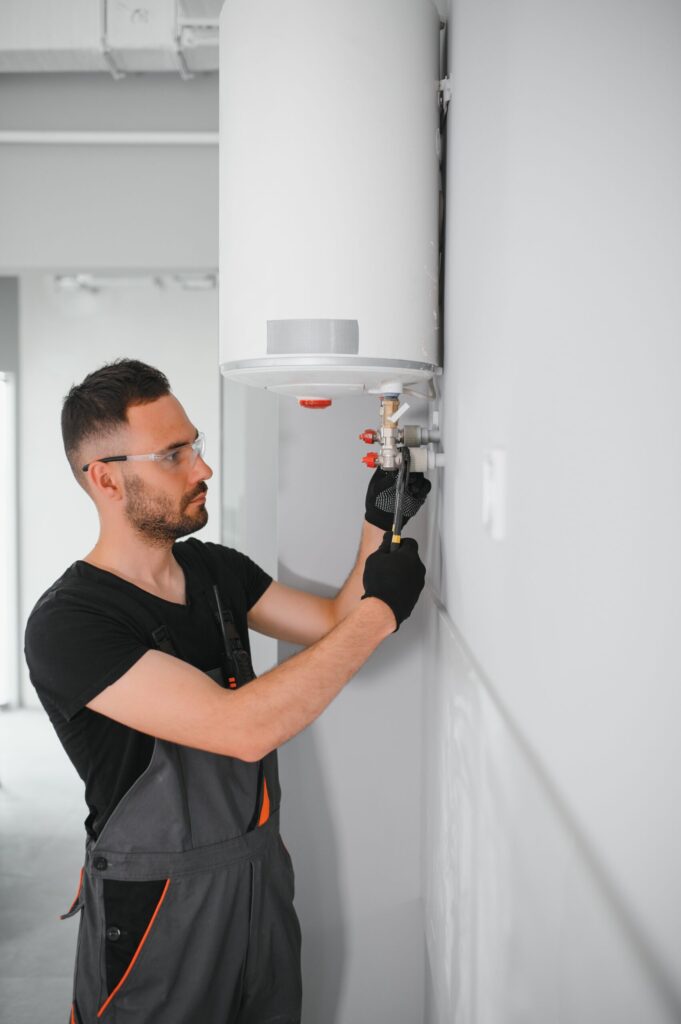
What Our Water Heater Maintenance Includes
Annual Tank Flush
Drain, flush and refill with the drain valve and relief train checked first, so the service does not create the leak it was meant to prevent.
Anode Inspection and Replacement
The rod pulled, measured and replaced where it still buys useful life, with the finding recorded for the next visit.
Relief Valve and Expansion Check
The T&P valve tested and replaced if it will not reseat, the expansion tank charged or added on a closed system, and the discharge pipe confirmed.
Combustion and Flue Service
Draft hood, flue condition, clearances and combustion air on gas tanks, with spillage treated as a safety finding rather than a note.
Tankless Descaling
Exchanger descaled, inlet screens and flow sensor cleaned, gas pressure checked, and the error history reviewed before the unit fails on a cold morning.
AREAS WE SERVE
Water Heater Maintenance Across Salt Lake City
We service tanks along the Wasatch Front, from the Avenues and Sugar House to Sandy, West Jordan and Layton. Older homes get the flue and closet checks; newer homes get expansion, recirculation and tankless descaling.
Before the visit
Note the symptoms: popping, slow recovery, rusty hot water, a weeping relief valve or a pilot that will not stay lit. That short list directs the inspection.
On the visit
Tank isolated and cooled, anode pulled, relief valve tested, sediment flushed, flue and combustion air checked on gas, temperature measured at the tap.
What you receive
A written condition report: anode remaining, sediment level, relief and expansion status, flue finding, and the temperature setting with the reason for it.
What happens next
Parts that need replacing are quoted separately. If the tank is past ten years with a spent anode, the report says so and the replacement can be planned rather than discovered.
Book the visit before the heating season: call (385) 486-0176. HVAC Company Salt Lake City will flush the tank, pull the anode, test the relief valve and tell you how much life the tank actually has left.
Salt Lake City
South Salt Lake
Millcreek
Holladay
Murray
Taylorsville
Cottonwood Heights
Sandy
Midvale
West Jordan
South Jordan
Draper
Bountiful
Salt Lake City HVAC — Frequently Asked Questions
The maintenance questions we answer most often on Salt Lake City calls.
Once a year suits most Salt Lake City homes, and the flush is worth more on a tank that has never been done than on one that is serviced annually. The caveat is condition: on an older tank with a corroded drain valve or a bottom that is already failing, the flush has to be assessed first rather than performed on principle.
Check the relief valve discharge for drips, keep the area around the tank clear, note any change in how long hot water lasts, and have the anode inspected. The anode is the one item a homeowner cannot reasonably check alone, and it is the one that decides how long the tank lasts.
In this market it is a combination: sediment on the tank bottom and a spent anode. The sediment causes the rumbling and the slow recovery; the anode decides when the steel starts to corrode. Pilot and thermocouple faults are common too, but they announce themselves, while the other two stay quiet until the tank leaks.
Six to twelve years for a standard atmospheric-vent tank, with the low end common where the anode is never checked. A tank that is past ten years, leaking at a seam or showing rust in the hot-water line is at the end of its life even if it still heats water.
Usually not without an inspection first. At fifteen years the tank is past its expected life, the drain valve may not reopen, and disturbing a corroded bottom can start a leak. The honest answer at that age is to check the anode and the tank condition, then decide between a flush and a planned replacement.
Working fine is the condition where maintenance pays. The checks that matter, anode condition, relief valve operation, flue draft and expansion control, are exactly the ones that fail silently. A tank that is working and past eight years is the one worth inspecting.