
Water Heater Installation & Replacement in Salt Lake City, UT
We size, vent and install gas, electric and tankless water heaters, and we tell you what the space will and will not accept before anything is ordered.
Replacing a water heater is not a swap. The tank has to fit the space, the flue has to draft, the gas line or circuit has to carry it, and in a city where the median house was built in 1963, the closet was sized for a tank nobody makes any more. Salt Lake City homes run 5,154 heating degree days a year (NOAA), so the replacement is asked to work hard from the day it is installed.
Why Choose Us for Water Heater Installation in Salt Lake City
We size the tank to the house, not to the shelf
First-hour rating, not tank volume, is what decides whether a household runs out of hot water. We count the bathrooms, the appliances and the peak hour, then match the rating. A larger tank on a short draw pattern wastes fuel; a smaller one with a good rating often serves the house better.
Venting is designed before the tank is ordered
At 4,579 feet (USGS) a gas appliance has less oxygen per cubic foot of air, so draft and combustion air are not a formality. Atmospheric tanks need a proper flue rise and a draft hood; power-vent and direct-vent units solve different problems. We pick the venting category first, because it decides which tanks can go in the space at all.
The permit and the inspection are part of the job
In the valley, replacing a water heater is permit work under the Greater Salt Lake Municipal Services District list, and Salt Lake City runs its own mechanical permit process through the Citizen Access Portal. We confirm the requirement for your address and build the inspection into the schedule rather than leaving it to you.
Old houses get old-house solutions
A 1963 closet may not fit a taller tank, a shared masonry flue may not accept a second appliance, and a closed system needs a thermal expansion tank. Those are the three things that turn a replacement into a second visit when nobody checked first.
Why Water Heater Replacement Can't Wait in Salt Lake City
A tank fails at the worst possible moment because that is when it is working hardest. In Salt Lake City the January normal low is 24.2 degrees Fahrenheit and the airport averages 51.9 inches of snow a season (NOAA 1991-2020 normals), so a tank that quits in a cold snap takes the hot water and the laundry with it and puts a wet floor under a house that is already cold.
There is a safety side too. An atmospheric tank that spills at the draft hood, a flue that has been orphaned by a later high-efficiency furnace, or a relief valve with no expansion tank are all problems that a replacement is supposed to solve. Installing a new tank on the old venting arrangement carries the old problem forward, which is why the venting check comes before the order.
Waiting also costs choice. A planned replacement is sized, vented and scheduled; an emergency replacement is whatever fits the space that day. The difference in outcome is usually not the tank, it is the half hour nobody had to measure the closet.
The last reason is the permit calendar. An inspection has to happen, and a scheduled replacement books it in sequence, while an emergency one tends to run without it until somebody notices. That is the outcome to avoid in a house you may sell.
WHAT A REPLACEMENT INVOLVES
Proof: What a Water Heater Installation Covers Here
A water heater installation is five decisions wearing a plumbing job: what size, what heat source, what venting, what safety chain and what the space will allow. Each of the six blocks below is one of those decisions, and each one is settled before the truck is loaded. This is also where a replacement on an older Salt Lake City home diverges from a replacement in a house built last year, because the housing stock decides the venting and the space. The median structure in the city dates to 1963 (ACS 2023), and roughly forty-eight percent of the stock predates 1970, which is exactly the era of narrow closets, shared masonry flues and fuse-era electrical panels. Read each block as the question we have to answer for your house before a tank goes in.
First-Hour Rating and Tank Sizing
Tank volume tells you how much water sits in the tank; first-hour rating tells you how much hot water the heater can deliver in the busiest hour, and that is the number that decides whether a household runs out. A family of four with two showers, a dishwasher and a laundry cycle can outrun a small tank with a fast recovery, while a larger tank with a slow burner can disappoint a household that draws in bursts. We count fixtures, occupants and peak-hour habits, then match the rating to the draw. Sizing also sets the recovery: a gas tank recovers faster than an electric tank of the same volume, which is why an electric replacement sometimes goes up a size to deliver the same first-hour rating.
Atmospheric, Power-Vent and Direct-Vent Gas Tanks
Most Salt Lake City homes heat water with natural gas: 73 percent of occupied units use utility gas (ACS 2023, B25040). The three venting categories are not interchangeable. An atmospheric tank uses room air and vents by natural draft, so it needs a chimney or flue with proper rise and make-up air. A power-vent tank uses a fan and can vent horizontally through a sidewall, which solves a closet with no chimney. A direct-vent unit seals combustion air from outside and is the answer for tight spaces and sealed rooms. Choosing the category first tells you whether a standard replacement is possible or whether the venting has to change with it. That choice is made from the room, not from a catalogue.
Tankless Retrofits: Gas Capacity, Venting and Flow
A tankless unit heats water on demand, which changes three things at once. The gas line usually has to be larger, because the burner fires at a much higher input than a storage tank. The venting is different again: condensing tankless units vent in PVC and produce acidic condensate that needs a drain path. And the unit is sized by temperature rise and flow, not by tank volume, so a cold Utah inlet in January means less usable flow than the brochure figure suggests. A tankless retrofit is a good answer for some houses and a poor one for others, and the gas line, the vent route and the simultaneous-fixture count are what decide it. A recirculation loop changes the answer again.
Thermal Expansion, Closed Systems and the Relief Valve
When water heats it expands, and in a closed system with a backflow preventer or a pressure-reducing valve that expansion has nowhere to go. The result is a relief valve that weeps, a tank that runs at the edge of its rating, and eventually a failed valve or a split connection. A thermal expansion tank gives the water somewhere to go and is standard on a well-built replacement. We check supply pressure, confirm whether the system is open or closed, and test the relief valve and its discharge pipe. Installing a new tank on a closed system without expansion control is how a good tank gets a bad reputation. The check takes minutes and prevents a repeat visit, and it is the difference between a tank that lasts and one that weeps from the start.
Location, Freeze Risk and the Discharge Path
A water heater in a garage, an attic or an unheated crawlspace is exposed to the part of a Salt Lake City winter that reaches the teens, and a tank or a supply line in that space can freeze during a cold snap. Location also decides the discharge path: a relief valve needs a pipe that runs to a safe drain or the exterior, not a bucket. We look at where the tank sits, what happens under it, whether a pan and drain exist and where the discharge would actually go. Those details do not show up in a tank specification, and they are the ones that decide whether the installation is correct rather than merely complete. A garage tank on a bare slab is the common case.
Permits, Inspection and the Mechanical Room
Replacement is permit work in the valley: the Greater Salt Lake Municipal Services District lists installing or replacing a water heater on its permit list, and Salt Lake City Building Services runs its own application process through the Citizen Access Portal, where mechanical permits are separate from the building permit. An inspection checks the things a homeowner cannot see later: the flue, the relief valve, the gas connection and the clearances. We confirm the requirement for the address, coordinate the inspection and leave the paperwork with you. If a furnace shares the room, its venting is checked at the same time, because the two appliances compete for the same air. That is also the moment to photograph the installation and record the model number, because a warranty claim years later goes nowhere without it.
THE LOCAL SCENARIO
The Scenario Nobody Covers: Replacing Into a 1963 Mechanical Closet
The median Salt Lake City house was built in 1963, and roughly forty-eight percent of the housing stock predates 1970 (ACS 2023). Those mechanical closets were designed around a short, narrow tank venting straight up a masonry chimney, and the modern catalog does not fit that footprint without a decision.
The first problem is the alcove. A taller, wider tank may not clear the door, the shelf above it or the gas line stub. The second is the flue: many of these homes share one chimney between the water heater and the furnace, and if a high-efficiency furnace has been added, the flue can be orphaned, which changes what the water heater is allowed to do. The third is air. A closet with a solid door and no louvres starves an atmospheric burner, and at 4,579 feet the margin is thinner than at sea level.
The answer is usually one of three paths: a shorter power-vent tank that vents horizontally through the wall, a direct-vent unit that brings its own air from outside, or a rework of the closet and flue before a standard tank goes back in. None of those is a default. Each is a decision that has to be made with the closet open, the flue visible and the measurements in hand, which is why we look before we quote a replacement.
In practice the assessment is the whole job. Once the space, the flue and the gas or electrical capacity are known, the tank choice is mostly arithmetic, and the installation stops being a surprise. That is the difference between a replacement that takes an afternoon and one that takes a week and a second contractor.
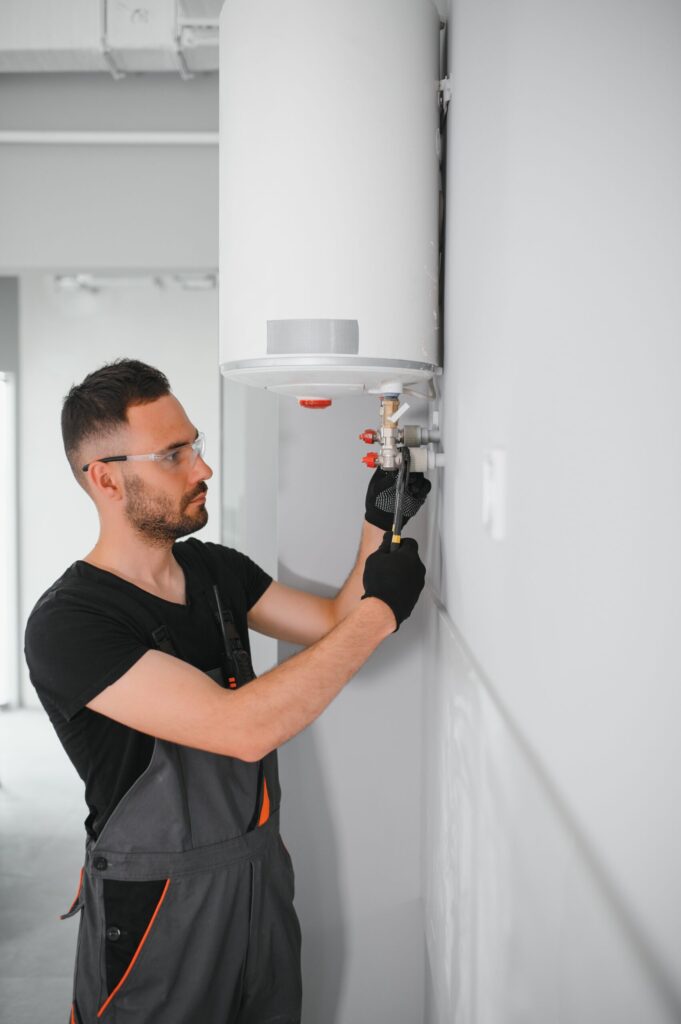
What Our Water Heater Installation Covers
Gas Storage Tank Replacement
Like-for-like replacement where the space, flue and gas line allow it, with the relief valve, expansion control and venting checked before the new tank is set.
Power-Vent and Direct-Vent Installation
For closets with no usable chimney or rooms that need sealed combustion air, horizontal venting through a sidewall with the clearances the manufacturer requires.
Tankless Water Heater Installation
Gas capacity, venting, condensate and flow at Utah inlet temperatures, plus the recirculation question that decides whether a tankless unit feels instant or slow.
Electric Water Heater Replacement
Element and circuit checks, correct voltage and breaker sizing, and a first-hour rating that matches the household rather than the old tank’s label.
Expansion Control and Safety Upgrades
Thermal expansion tanks on closed systems, relief valve and discharge pipe corrections, pans and drains, and shut-off valves that will actually close next time.
AREAS WE SERVE
Water Heater Installation Across Salt Lake City and the Valley
We install along the Wasatch Front, from the Avenues and Sugar House to West Jordan, Herriman and Draper. The housing era decides the work: pre-1970 homes bring closet, flue and panel questions, newer homes bring expansion tanks, recirculation loops and tankless retrofits.
The space assessment
Alcove dimensions, door clearance, flue route, gas line size or circuit capacity, and where the discharge pipe can legally run.
The venting decision
Atmospheric, power-vent or direct-vent, chosen for the room rather than for what is on the truck, with combustion air accounted for.
The safety chain
Relief valve, expansion tank, pan and drain, shut-off, and the gas connection tested after the install rather than assumed.
The old tank
Drain, disconnect, removal and haul-away, plus a look at the floor and the connections the old tank was hiding.
The paperwork
The permit path for the address, the inspection, and the model and serial numbers recorded so the warranty is not lost in a drawer.
The first-hour check
Hot water at the taps, the relief valve and the flue checked after commissioning, and the temperature set with the household's scald risk in mind.
Call (385) 486-0176 before the old tank gives out. HVAC Company Salt Lake City will measure the closet, check the flue and the gas or electrical capacity, and tell you which replacement actually fits the house.
Salt Lake City
West Valley City
Murray
Millcreek
Holladay
Cottonwood Heights
Sandy
Midvale
West Jordan
South Jordan
Draper
Riverton
Layton
Salt Lake City HVAC — Frequently Asked Questions
The questions that come up before a replacement in Salt Lake City, answered the way we answer them on the assessment.
It is possible in some jurisdictions, and it is a poor idea in this one. The work involves gas connections, flue draft, a pressure vessel and a relief valve, and replacement is permit work under the Greater Salt Lake MSD list, with Salt Lake City running its own mechanical permit process. A mistake in venting is a carbon monoxide problem, not a leak, and an unpermitted install can surface years later at a sale.
It depends on the house. Tankless units save space and never run a standby tank, but they need a larger gas line, a different vent and a drain for condensate, and cold January inlet water reduces usable flow. A household with simultaneous showers and a long gas run may be better served by a well-sized storage tank with a good first-hour rating.
In the valley, yes: the Greater Salt Lake Municipal Services District lists installing or replacing a water heater as permit work, and Salt Lake City Building Services runs its own permit application process, with mechanical permits separate from the building permit. Requirements are address-specific, so confirm with Building Services for your property before the work starts.
A straightforward like-for-like tank replacement is usually a single visit. The schedule stretches when the closet has to be modified, the flue has to be reworked, a power-vent or direct-vent unit is going in, or the gas line has to be resized for a tankless unit. That is why the assessment happens before the order.
Size it on the first-hour rating rather than the tank volume. Four people with two bathrooms and a dishwasher usually need a rating that covers the morning peak, which often means a mid-size tank with strong recovery rather than the largest tank available. The draw pattern matters more than the headcount.
Usually, yes. A tankless burner fires at a much higher input than a storage tank, so the existing half-inch run often has to be increased and the meter capacity checked. That is one of the reasons a tankless retrofit is a design decision rather than a swap, and it is checked before the unit is ordered.